Friday, November 27, 2015

it's a fake add with a good purpose!

This Fake Ad Just Might Have the Power to Inspire Millennials to Ditch Single Use Plastics for Good (VIDEO)


If you look closely at advertisements aimed at Millennials – people who came of age after the year 2000 – certain trends quickly become apparent. They tend to focus on the glories of youth and freedom: partying, dancing, chilling out, and stress-free times. The assumption seems to be that Millennials live for the moment and never think about what their actions might lead to in the future.

It is exactly this devil-may-care attitude that reusable bottle brand Bobble has lampooned in their new fake bottled water commercial, Once. The video is aimed at encouraging Millennials to think more carefully about their plastic consumption habits. Though the “commercial” seems, at first glance, to be light-hearted and fun, it makes a very serious point: “‘Once’ never thinks twice … That’s why we drink tomorrow, today. No consequences, no regrets. Someone else can clean up our mess while we live for ‘Once’.” The video ends with the message: “Time to end single-use plastics.”

Bobble’s message could not be more urgent or timely, as our planet is currently being engulfed by a steadily-growing plastic crisis. Americans consume around 10 billion gallons of bottled water per year – and every single bottle takes thousands of years to decompose. Even when it does disintegrate, it never truly “disappears,” but simply pulls apart into millions of minuscule fragments. It is believed that 270,000 tons of plastic debris are currently held in the world’s oceans, threatening an estimated 700 marine species with extinction.

There’s really no excuse for single use because all that “once” lasts a lifetime – and beyond.

To find out how you can reduce your consumption of plastic, read some of the articles below:

  •  10 Simple Actions That Just Might Save Our World’s Oceans From Plastic 
  • 5 Simple Go-To Tips to Shrink Your Plastic Footprint 
  • 10 Life Hacks to Help You Cut Plastic Out of the Picture 
  • How to Ditch Single-Use Items and Reduce Your Impact on the Planet 
  • 5 Innovative Ways to Use Unavoidable Plastics in Your Life

The soul is the same...

Ancient Greek wise man Hippocrates, father of medicine, said it. :)
And we are indeed a big family of many species, earthlings all of us, cells of the Earth's body.  Just human is the naughty one who risks all lives, even his own.
The soul of all creatures is the same...

May all souls be free and happy
Posted by Carol Sakai on Sunday, 22 November 2015

Thursday, November 26, 2015

Humpback whales come back in Australia

Let's celebrate! The whales return to the waters of Australia! Does this mean that the oceans still have hope for life to return also? Is humpback whales a sign that nature CAN reverse somehow the human damage? I hope this is a lesson of respect and these wonderful creatures will keep on swimming free and proud.

Humpback whales are making a comeback in Australia. Share the good news!
Posted by Faunalytics on Tuesday, 10 November 2015

Wednesday, November 25, 2015

France Becomes First E.U. Nation to Ban Lion Trophies

France makes the difference!!!

http://www.ecorazzi.com/2015/11/22/france-first-e-u-nation-to-ban-lion-trophies/#.VlOEA9oyyTw.facebook

Some four months following the murder of Cecil the Lion, while protests and petitions remain, nations have been slow to take decisive action. Joining a small though hopefully growing list of countries, France has banned the import of lion heads, paws, skins, and other so-called hunting ‘trophies.’
Permits will no longer be issued for lion trophies, and there may be stricter enforcement on other animal trophies looming as well, wrote France’s environmental minister Ségolène Royal in a letter.
“Concerning other species trophies,” she wrote, “I am in favour of a much stronger control for hunting trophies and this issue will be discussed with all the countries concerned and with the EU.”
France is the first state in the European Union to act as such, though the entire EU was called upon by conservationists this past summer to ban lion trophies. International outrage was sparked after a dentist from Minnesota slaughtered Cecil, a beloved and protected figure in Zimbabwe’s National Park.
In four years from 2010 to 2013, more than 100 lion trophies were imported to France. The ban should have a symbolic effect as well, with France leading the E.U. In March, Australia banned lion trophy imports, while Botswana followed suit after Cecil’s death.
“Within the EU, France was a major importer of such trophies and we expect that wild lions will now find themselves safer without the presence of French trophy hunters,” said a spokeswoman for Lionaid, a U.K.-based charity. “We trust that France’s decision will create a domino effect within the EU and that we will soon hear about other member states joining together to say no [to trophies].”
Hunting isn’t the only threat to African lions however. Last month, scientists forecasted the lion population in central and western Africa may halve due to a loss of prey and habitat. What’s more, hunting bans pose a problem for African communities reliant on the money it brings.

Tuesday, November 24, 2015

Protesters picket Livonia’s Roperti’s Turkey Farm

An other way for thanksgiving - with mercy - without turkeys


(Photo: Brad Kadrich)
 
9:38 a.m. EST November 22, 2015 
Brad Kadrich, bkadrich@hometownlife.com
Courtney Jacobs acknowledges Roperti’s Turkey Farm is a Livonia icon, having done business in the city since 1967.
But that didn’t stop Jacobs, the director of DetroitCowSave, from organizing a protest outside the gates of the long-established turkey farm Saturday in an effort to raise awareness of animal cruelty.
Jacobs and about a dozen protesters spent an hour standing on 5 Mile Saturday, holding signs objecting to the operation less than a week before Thanksgiving.
“We just want to raise awareness there are other ways to celebrate Thanksgiving,” said Jacobs, who holds a bachelor’s degree in health services from Oakland University. “Sentient beings don’t have to be killed just for tradition.”
It was the second straight year DetroitCowSave picketed Roperti’s. A similar-sized group spent an hour in the same spot a year ago.
Roperti’s owner Christine Roperti was unfazed by the protest, shrugging it off as a group on an ultimately unsuccessful effort to change people’s thinking.
“They’re not going to change the world,” Roperti said. “If they want to be out there for an hour ... whatever. It doesn’t matter to me.”
Roperti questioned the tactics of the group, wondering if the group had protested Huron Turkey Farm (on Merriman Road in Romulus) — Jacobs acknowledged the group had not — or other similar businesses in the area.
“I think they’re actually harassing me,” said Roperti.
Laurice Bray founded DetroitCowSave, a grassroots organization dedicated to raising awareness about the suffering of factory farmed animals. She said the protest was not only about getting people to give up turkey for Thanksgiving, but it’s also about the treatment of the turkeys.
“We’re out here because we feel these turkeys are not unlike any other animal ... Turkeys are very intelligent,” said Bray, who grew up in Livonia and now lives in Farmington Hills. “We know we’re not going to change a lot of minds. Roperti’s is a Livonia institution. (But) People are going to (eventually) embrace a kinder, gentler lifestyle that doesn’t include killing animals.”
While Roperti dislikes the group’s methods — she claims they’ve lied to state inspectors about Roperti’s, for instance — she is unfazed by their presence and expects to sell some 4,500 turkeys this holiday.
“I like it when (protesters) come,” Roperti admitted. “(Customers) come running through the door when they’re here.”
bkadrich@hometownlife.com
Twitter: @bkadrich

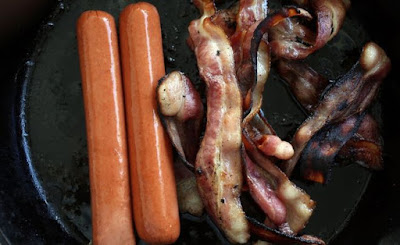
Norway: Hotel chain bans bacon and sausages

Norway: Hotel chain bans bacon and sausages from its plates.  It's a great example of how things are getting to become.  Slowly but steadily companies realize that vegeterianism and veganism sell and they get along with the new way.  A clever businessman? A vegan or someone who has just observed what bacon really is?

  • 18 November 2015
A Norwegian hotel chain has risked raising the ire of travellers by banning bacon and sausages from its breakfast menu, it's been reported.
Comfort Hotels will replace the traditional greasy breakfast items with plant-based foods to encourage a more climate-friendly, healthy lifestyle, the Hegnar.no news website reports. Guests will also see a reduction in the amount of cereals and cheese on the menu, and the chain won't serve products containing palm oil, which it says is environmentally destructive. The Comfort Hotels chain is part of the Nordic Choice hotel group, which operates more than 170 establishments in Scandinavia and the Baltic.
The group's owner, Petter Stordalen, tells Hegnar that "focusing on sustainability is what we do", adding that he believes guests "will appreciate a good, healthy start to the day", instead of a plateful of pork products. The move comes in the wake of a World Health Organisation report which linked processed foods such as bacon with colon cancer.
It's a decision that hasn't gone down well with some customers, according to the Swedish Vasterbottens Kuriren news website. While an employee at one of the chain's hotels in Sweden says there have been "mixed reactions", another hotel worker is more forthright, saying: "Personally, I think bacon and scrambled eggs should be the standard in a hotel breakfast." That appears to be a view shared by the paper's online readership, with 70% voting for "I need bacon for breakfast!" in a straw poll on their website. The pork-free scheme is still being trialled, and the chain says it is open to customer feedback.

Monday, November 23, 2015

America's new good way for water


Using rain water for domestic irrigation is a great way to conserve and cut back on fresh water usage! What do you use harvested water for?

Posted by American Rainwater Catchment Systems Association (ARCSA) on Wednesday, 18 November 2015

Sunday, November 22, 2015

U.S. puts an end to all experiments on chimps


The National Institutes of Health is shuttering its chimpanzee research program after decades of experimentation and research that has put animal rights activists and scientists at odds.
Two years after sending more than 300 of its research champs into retirement, the NIH said on Wednesday that it will place the final 50 chimps into sanctuary. The move puts an end to government-led experiments on chimpanzees, the primate most closely related to humans. Chimp DNA is nearly 99 percent identical to human DNA.
"It's time to say we've reached the point in the U.S. where invasive research on chimpanzees is no longer something that makes sense," Dr. Francis Collins, director of NIH, told the Associated Press.
The news was heralded by animal rights groups. “We really see the [NIH] closing and locking the door behind the chimps and throwing away the key on their way out of the laboratories,” Wayne Pacelle, president and CEO of The Humane Society of the United States, wrote in a blog post.
The NIH first established primate research facilities in 1960. But in the past few years, under increasing outside pressure, the agency had scaled back its work. In 2013, the NIH retired all but 50 chimps, hanging on to them in case they were needed for some essential research.
But in the past nearly three years, not a single request for research on a chimp has been made. “[W]e have moved on from the time when research on chimpanzees was considered essential," Collins told the journal Nature.
Wednesday’s news did not come without some backlash. Some scientists working on a vaccine to protect chimps in the wild from the Ebola virus decried the decision. Others wondered if some future health crisis would be worsened without chimps available for testing.
The final decision by the NIH was not made without some arm-twisting and years of bureaucratic machinations. The NIH asked the Institute of Medicine (now the National Academy of Medicine) to look at the need for chimp research back in 2010, and the IOM came back with a report in 2011 that determined most of it was unnecessary. That led to the retirement of hundreds of chimps in 2013.
Then in June, the U.S. Fish and Wildlife Service classified captive chimps in the U.S. as an endangered species, so any experiments on the remaining 50 chimps would have had to been OK’d by that agency.
Now, the NIH will spend the next couple of years relocating the chimps from facilities in Texas. Most, if not all of them, will end up in a 200-acre federal chimpanzee sanctuary in Keithville, Louisiana, called Chimp Haven. (If you haven't watched the video below of chimps exploring their new environment at Chimp Haven — literally stepping on grass and seeing the sky for the first time in their lives — it's worth a watch.)
The 50 chimps, now housed in facilities throughout Texas, are not the only ones that will eventually need homes. More than 150 other chimps, supported by the NIH but not owned by the government, will need to be relocated, according to Nature. And there are more chimps out there that need a home, the Humane Society’s Pacelle said in his blog post.
“Approximately 700 chimpanzees remain in laboratories with around 300 owned by the federal government.” he wrote. “But we are working on travel plans for every one of them … The HSUS stands ready to work with stakeholders, including the government, Chimp Haven and other sanctuaries, laboratories, the public, and other animal protection groups, to ensure all chimpanzees are retired to high-quality sanctuaries.”

Help Save the Cheetah ...in NYC

New York City sign promotes the need to save cheetah, one of the wild animals in great danger. We need more than this but raising awareness is one way to a solution.

Saturday, November 21, 2015

You don't have to love animals...

...instead love your planet that is your only home, love yourself and your health... You don't have to love animals, just to leave them alone to live the lives of their own...!

It's not pigs' fault...

Pigs and cows and chickens just die horrible deaths after an even worst short miserable life...! How much do you want your meat?

You call me preachy and judgemental, just because I'm trying to stop THIS? Apparently, I care more about your kids than...

Posted by Amanda Octeau on Thursday, 19 November 2015

Thursday, November 19, 2015

Vegans In The Renaissance | The History Of Veganism Part Three

Part Three of the History of Veganism - as seen from Bite Size Vegan...!

His Life Matters...

Miguel is a lucky pig. But other pigs, billions of them, are not lucky at all!!!

This is Miguel. Like all pigs, he is a gentle, friendly and peaceful being.A unique video. Please share to raise awareness.

Posted by Best Video You Will Ever See on Tuesday, 20 October 2015

Wednesday, November 18, 2015

9 Women Who Are Saving the Planet!

9 Women Who Are Saving the Planet


What happens when a group of intelligent, educated, optimistic and driven women put their talents to work? They save the planet, that’s what.
Meet the women who are at the forefront of the animal rights and environmental movements, changing the world for the better every single day like a girl a boss.
1. Jane Goodall
In the early 60s when the idea of a woman’s career was to have a secretary job, Jane Goodall packed her things and moved to a tent in Africa to observe chimpanzees in the wild. She had no college degree or credentials but she was committed and in just a few months she was able to make new findings that changed anthropology. She also bonded deeply with the primates to which she would dedicate most of her life.
Today, at 81-years-old, Goodall travels 300 days out of the year doing talks and speeches to spread her message about the importance of conservation and emphasizing personal responsibility to get others to care and do their part. Meanwhile, her nonprofit, the Jane Goodall Institute, which she founded in the 70s, has 19 offices worldwide and works nonstop to conserve and protect natural habitats all over the world.
2. The Black Mambas
A group of 26 young local women called The Black Mambas patrol Greater Kruger national park in Africa to protect the wildlife living there from poachers.
In a place where there was a clear divide between the rich trophy hunters in the park and the poverty outside its boundaries, the women got the community surrounding the park involved in conservation instead of having to contribute to poaching to earn enough to put food on the table.
It may sound like a dangerous job but the women are up to it.
“I am a lady, I am going to have a baby. I want my baby to see a rhino, that’s why I am protecting it,” said Leitah Michabela who’s been a Black Mamba the last two years. “Lots of people said, how can you work in the bush when you are a lady? But I can do anything I want.”
3. Dr. Sylvia Earle
Oceanographer Dr. Sylvia Earle is also known as ‘Her Deepness’ for her accomplishment holding the deepest-dive record for her 1250-foot free dive. The Library of Congress calls her ‘A Living Legend’ but her actual current job title is National Geographic Explorer in Residence.
Earle has spent over 60,000 hours underwater, spoken before Congress about defending our oceans and even though she was named chief scientist for NOAA (National Oceanic and Atmospheric Administration) in 1990, she abdicated the title after one meeting so she could get more accomplished as a private citizen.
The documentary ‘Mission Blue’ on Netflix chronicles her story and her desire to make everyone understand that “the ocean is dying. No ocean, no life. No ocean, no us.”
4. Gabriella Cowperwaith
Gabriela Cowperwaith doesn’t consider herself an animal activist but through her work directing ‘Blackfish’ she has unintentionally led one of the biggest animal rights campaigns of the last five years.
The documentary filmmaker has directed, produced and written a number of movies in her 12 year career and started her work with ‘Blackfish’ “as a mother who had just taken her kids to SeaWorld” and was curious on why the whales were showing violent behavior towards their trainers.
Her film exposed the cruelty inflicted upon the whales by the theme park and since its release in 2013, SeaWorld’s attendance has plummeted, along with its stock, revenue and public image. Still, Cowperwaith says her goal is never to change people’s minds.
“I trust that once audiences are armed with the truth, they will make the best decisions by themselves and their families,” she told CNN.
5. Cindy Lowry
Cindy Lowry has dedicated more than 25 years as an environmental activist to protecting and saving marine wildlife and the marine environment. She is most known for being the driving force in saving the lives of three whales that got caught in the Alaskan ice in 1988.
The ordeal, which recently was retold in the feature film ‘Big Miracle’ with Drew Barrymore playing Lowry, changed the then executive director of Greenpeace in Alaska’s life and put her in the national spotlight.
“There were these two holes [in the ice] and even the larger of the two was only just large enough for two [of the three] whales to breathe,” Lowry recalled to Discovery News. “[We] walked over there and my immediate thought was, ‘God, this is when you wish you were Superman and could just go in and scoop them out of there.’”
In a time before smart phones when a picture of the whales could have gone viral, Lowry had to call everyone from the Governor’s office to the U.S. Coast Guard and National Guard to get someone to cut the ice so the whales could swim back into the ocean.
After the whales were set free, one of them came up to her and blew on her face as a form of thank you. She still thinks of those whales but today Lowry, a self proclaimed eternal optimist, works to protect marine ecosystems from the installation of offshore developments for renewable energy, as well as oil and gas.”
6. Stella McCartney
When you grow up as the child of Paul McCartney and Linda Eastman McCartney, it’s no surprise you’ll be a vegetarian and an animal lover.
The now super successful fashion designer grew up in an organic farm in Sussex with sheep, horses and a vegetable garden. She was raised “to respect animals and to be aware of nature, to understand that we share this planet with other creatures” as she told in a 2009 interview with The Guardian, and she kept those values in adulthood.
Leather and fur are completely verboten at the Stella McCartney brand, making it a favorite of eco-conscious celebrities like Anne Hathway. The brand’s boutiques are eco-friendly, with wood flooring taken from sustainably managed forests, repurposed vintage furniture, and powered by renewable energy sources.
McCartney also worked with her family to launch the Meatless Monday initiative that encourages meat eaters and specially schools to ditch the meat once a week for the environment.
7. Kinessa Johnson
Poachers may try to illegally hunt wildlife, specially rhinos, but Kinessa Johnson is making their plans a lot harder. The Afghanistan veteran from Yelm, Wash., hunts poachers before they can strike and kill animals.
Her hunting is not violent, though. Even though she is very much armed, as her Instagram account shows, her work with Veterans Empowered to Protect African Wildlife (VEPAW) consists or spotting and detaining poachers, not hurting them. She is also part of a group that trains other park rangers to catch and detain the wildlife killers.
8. Carol Buckley
Carol Buckley has been working with elephants in captivity for more than 30 years.
As the co-founder of The Elephant Sanctuary in Tennessee, the first natural habitat refuge for sick, old and needy elephants, she has saved 24 elephants. As the president and CEO of Elephant Aid International, she works with governmental agencies and private organizations to develop stronger regulations protecting the welfare of elephants in captivity.
Since 2013 Buckley has been traveling to Asia installing chain free fences that allow elephants to roam instead of living their lives in captivity.
“There’s an incredible shift in their posture and in their eyes when they go chain-free,” Buckley told Care2 earlier this year. “Most of them are present during construction so they know what’s going on. One of the ways they survive in chains is that they check out. They’re not there mentally but when they’re freed they lighten up and their heads lift up higher. They play!”
9. Suzy Amis Cameron
Suzy Amis Cameron is all about decreasing our carbon footprint to save the environment.
“For 25 years, I’ve dedicated myself to learning all I can about the environment and its health. The more I discover, the more I realize that my health and actions are intimately, intricately, intertwined with the biosphere,” she explains in her website. “This has led me to want to do everything in my power to understand and champion sustainable values, from what we wear, to how we teach our children, to the food we eat.”
The environmental advocate is vegan and got her very famous husband, James Cameron, to make the diet switch as well. Nine years ago, she cofounded MUSE School in California, the first school in the country to have a 100 percent plant-based lunch program and that puts great emphasis on environmental consciousness.
In New Zealand, she’s founded Food Forest Organics, a vegan marketplace and cafe. In the U.S. she started the Red Carpet Green Dress challenge that urges designers to create eco-friendly fashion.
Photo Credit: Jane Goodall Institute