Hawaii To Become The First US State To Ban Wild Animals From Performing
Hawaii is set to become the first U.S. state to ban
the use of bears, elephants, big cats, and other exotic wild animals for
entertainment purposes.
Credit: yucatanexpatlife.com
Earlier this week, the Hawaii Department of Agriculture board unanimously approved a set of proposed rules change that would prohibit the import of exotic wild animals “for exhibition or performance.” This means that Hawaii is set to become the first U.S. state to ban the use of bears, elephants, big cats, and other exotic wild animals for entertainment purposes.
This breaking news is being celebrated by animal rights activists around the globe.
Exceptions to the new rule would be commercial filming for television or movies and within government zoos. Reports World Animal News, the proposal included a ban on elephants, big cats, primates, rhinos, hippos, crocodiles, and bears, and hyenas.
Stated Inga Gibson, Hawaii’s senior state director for the Humane Society:
“We’re hoping of course that Hawaii will set an example for other states to take the next step.”
The 1994 documentary “Tkye Elephant Outlaw” reportedly
influenced the drafting of the proposal. Its focus is about an elephant
that escaped in the Honolulu states and was ultimately shot down by police.
At present, 50 municipalities in 22 U.S. states
and several countries have implemented partial or full bans on animals
used as entertainment. If this proposal goes through, Hawaii will come
the first state to implement the ban.
Credit: ThePlaidZebra
Says Gibson, the new rules may go into effect as soon as early 2016.
As one might expect, fair and circus advocates are anything but pleased about the news. The Circus Fans Association submitted a written testimony characterizing proponents of the measure as “animal rights extremists” who make false statements in relation to circus animal mistreatment.
While there are, no doubt, circuses and zoos that treat caged animals fairly and with respect, the issue comes down to ethics: Do animals belong in captivity or do they deserve freedom in the wild? Comment your thoughts below and share this breaking news!
This article (Hawaii To Become The First US State To Ban Wild Animals From Performing) is free and open source. You have permission to republish this article under a Creative Commons license with attribution to the author and TrueActivist.com
28 of November and London is on foot! But no coverage for this march! Doesn't it pay back enough?
Did you notice TV coverage of this MASSIVE anti war march in London today? No! Really? Are you wondering why yet? NOT IN MY NAME!
Posted by Rikey Austin on Saturday, 28 November 2015
Protein is important to our health, our workouts and recovery,
and our brain function; without it, we wouldn’t function at our best
and our bodies wouldn’t be able to support us long-term. However, the
problem with the view of protein in our country is where we’re getting
the majority of our protein from: animals. Regardless of different
opinions out there about including meat as a part of our regular diets,
we can’t ignore the fact that meat consumption is causing our major
environmental, health, and humanitarian problems. When you put all the
pieces together, it is stime we start looking for a real sustainable
alternative. Say hello to plants!
The Myth About Protein in a Plant-Based Diet
There used to be a myth
that we needed to consume different types of foods to form “complete
proteins” in the body. While this shouldn’t necessarily be ignored
completely, it’s also not as important as we once thought. There are
plenty of complete sources of plant-based protein that we can eat. Our
bodies can also make complete proteins when we eat a variety of higher protein foods, even
if those foods aren’t necessarily eaten together (such as rice and
beans, a classic example of protein pairings). One struggle, however, is
that many people aren’t sure how to replace the meat on their plate
with a plant-based protein they’ll love and enjoy as much as meat. So,
the simple thing is to quit focusing on just what our plates look like
at dinner.
How to Rethink Protein Once and For All
Get rid of the picture of a dinner dish in your mind that shows a
piece of meat, veggies, and a whole grain. While there’s nothing
particularly wrong with eating protein at a meal, it’s also not
mandatory for getting what you need. You can incorporate protein all
throughout the day on a plant-based diet, especially in snacks,
where it’s most often overlooked, without really needing a massive
source at every meal. You can also eat foods that contain smaller
amounts of protein at each meal that the body can use efficiently to
form proteins on its own, even if these foods aren’t as high as the
proteins in meat. Remember, the body can only use so much protein at one time anyway.
What it can’t digest the rest of during a meal can go to waste and even
be harmful to the body. A little here and there throughout the day
(especially focusing on protein at breakfast to regulate blood sugar) is
ultimately best. Try these 25 plant-based proteins and see just how satisfying they really can be!
Blind Man and His Armless Best Friend Have Planted Over 10,000 Trees in China
It doesn’t happen often, but every now and then you hear a story
about people overcoming all odds to help others and it completely
changes your perspective of the world. The story of Jia Haixia and Jia Wenqi is certainly one of these. Haixia and Wenqi are
two 53-year-old men from China who have faced incredible challenges in
their lives. Haixia was born with congenital cataracts that caused him
to be blind in one eye. He then lost sight in his one good eye after a
work accident in 2000. Wenqi tragically lost both of his arms in an
accident when he was only three years old and has been living as a
double amputee ever since.
Despite their physical setbacks, Haixia and Wenqi have remained
utterly determined to live life to the fullest. These two best friends
help one another navigate the world and when they’re together there is
nothing that they cannot do.
Adding to their amazing story of friendship is the fact that the pair have managed to plant over 10,000 trees over the course of the past 10 years.
“I am his hands,” said Haixia. “He is my eyes. We are good partners.”
The pair met in 2001 when they were both struggling to find work because of their disabilities.
Neither wanted to “give up” on life, so they hatched a plan to plant trees to earn money.
By planting trees, they could
give back to the community and ensure a better future for others. With
this idea in mind, they set out to lease three acres of land from the government and got to work.
Haixia and Wenqi rise every day at 7AM
and set out to plant trees. When they reach the busy stream they need
to cross to get to their site, Wenqi carries Haixia to the other side.
Money is tight, but the pair are determined to reforest their land. Unable to buy new saplings, they use cuttings from older trees to sprout new life.
When it comes time to scale trees to collect cuttings, Wenqi carefully directs Haixia, acting as his eyes.
The work requires much patience
and the fruits of their labors are not always apparent. But seeing young
saplings grow inch by inch is enough to bring Haixia and Wenqi peace of
mind.
“We stand on our own feet,” Wenqi tells Oddity Central. “The fruits of our labor taste sweeter. Even though we are gnawing on steam buns, we find peace in our hearts.”
A number of generous people have volunteered to help Haixia and Wenqi after hearing their story; one kind benefactor has offered to pay for a surgery that could help restore Haixia’s sight, and another has donated money towards their pensions to ensure they always have a good roof over their heads and enough food to eat.
Isn’t it amazing to see one kind action turn into countless others?
Take a page from these two today and help keep the compassion going! All image source: Mymodernmet
The plight of homeless animals often goes unaddressed across the world. In the U.S., there are around 70 million homeless dogs and cats, and a similarly dire situation can be found in India. With people often too poor to spay or neuter their animals, there are now tens of millions of homeless animals roaming the streets of India. Luckily, Animal Aid Unlimited is there to help. Animal Aid Unlimited is an animal rescue group in Udaipur, Rajasthan, India that works in the streets feeding and rescuing sick and injured animals.
When someone reported a dog whose skin had practically turned to
stone with scabs and crusty mange, they were quick to jump to her
rescue. The poor dog had taken up residence in an abandoned van and was
so skinny and sick that she barely noticed the volunteer when he showed
up. But when she finally did wake up, the poor girl was petrified, as
this was no doubt the most interest that a human had ever shown her.
It took staff members lots of time and dedication to soak off all of
the pup’s infected scabs, but after a few weeks, they finally got yo see
all the beauty that was hiding underneath!
If you would like to help Animal Aid Unlimited in their tireless rescue efforts, please visit their website by clicking here.
There is no mercy for beautiful animals. The more beautiful they are the biggest danger they are in.
[ENGLISH BELOW]300.000 lisów zostanie zabitych tej jesieni w Polsce, by zaspokoić popyt przemysłu modowego na futra....
Posted by Otwarte Klatki on Sunday, 22 November 2015
Meet the 3 Inspiring Women Who Changed Our Perception of Primates Forever
Until the 1970s, little was known about primates. We didn’t know, for instance, thatchimpanzees and gorillas use tools to perform tasks like catching food in the wild or thatorangutans have a strong maternal instinct. Not to mention, we had no clue how similar primates are to us humans. If it weren’t for the renowned anthropologist Louis Leakey and his belief that understanding primate behavior was vital to understanding the origins of humans, maybe we still wouldn’t today.
Convinced that humans had evolved from the apes, Leakey wanted primates to be studied in the wild – something that had never been done before. According to records from the Leakey Foundation, he was responsible for initiating Jane Goodall’s long-term field study of chimpanzees in the wild, and he helped obtain and coordinate funding for similar projects such as Dian Fossey’s work with mountain gorillas in Rwanda, and Birute Galdikas-Brindamour’s work with orangutans in the Sarawak region of Indonesia.
None of these three women had much scientific experience or knowledge and that is precisely what Leakey wanted: minds uncluttered and unbiased by science. Interestingly, some of the most groundbreaking discoveries in science would be made by this trio; Leakey’s Angels, as they came to be known.
Jane Goodall: Gombe, Binoculars, and David Graybeard
Jane Goodall Institute
Jane Goodall first began studying chimpanzees in Gombe Stream National Park, Tanzania in 1960. She came with no degrees, no experience, just patience, and passion. Every morning, she’d hike through the forests, with binoculars on hand, waiting to catch a glimpse of a chimpanzee in the wild. And, instead of numbering the chimpanzees she saw, she chose to unconventionally, give them names. David Greybeard was the first chimpanzee to accept her, the pale stranger in the forest, and this paved the way to a great deal of phenomenal research.
Among her incredible discoveries was that chimpanzees could make and use tools to perform basic tasks in the wild, like catching termites with stalks of grass or twigs from trees. She also learned that contrary to popular belief, chimpanzees were not vegetarians. Another interesting discovery was that chimpanzees possess great emotional depth, much like human beings and are capable of kindness, playfulness, grief, aggression and tenderness. They also share many of the same actions as humans, like hugging, kissing and tickling. These initial discoveries have shaped our modern understanding of chimpanzees and continue to evolve.
Although we are most familiar with chimpanzees, this species is listed as endangered due to the bushmeat and exotic pet trades. With a population teetering around 100,000, we stand to lose this species forever if action to combat these trades is not taken.
Dian Fossey: Rwanda and it’s Gentle Giants
In 1967, Dian Fossey entered the Virunga Mountains of Rwanda to set up camp and prepare for the study of mountain gorillas. Until this time, gorillas were generally considered an aggressive species, but Fossey soon debunked that myth, observing that while they are tough, they’re also incredibly gentle. Generally, they’re peaceful animals and only show bouts of anger when protecting their young.
Just like Goodall with chimpanzees, Dian Fossey saw gorillas as dignified animals with individual personalities, which is why she too named each gorilla with whom she was acquainted rather than merely numbering them. For nearly 20 years, Fossey lived among the mountain gorillas and soon grew attached to a male gorilla called Digit, who was later tragically decapitated by poachers.
In keeping with her research, Fossey found gorillas to possess a wide range of emotions and could construct tools. Instead of simply sitting there and observing, Fossey started imitating their feeding and grooming habits and vocalization in order to gain their trust and “fit in.”It was this deep empathy for gorillas that made her so effective as an ethologist.
Birute Galdikas: The Deep Emotions of Indonesia’s Orangutans
The third member of Leakey’s angels is Birute Galdikas and unlike the others, she was the one who approached Louis Leakey, proposing a research project into the lives of orangutans. Her studies began in 1971 in the jungles of Borneo.
Before Galdikas’s work, people thought orangutans were solitary creatures, but her research proved otherwise. In fact, the social and familial relationships of these primates closely mirror those of human beings. Orangutans maintain incredibly close relationships with their mothers for the first ten years of their life, they literally cling on to their mothers until they’ve reached at least seven. Like humans, orangutan mothers devote a lot of time and energy into raising their young. According to Galdikas’s research of their migration patterns, some populations will remain in their original home area while others will be more nomadic and venture off to other areas.
Another fascinating discovery made by Galdikas was that orangutans have the longest birth interval of all mammals. A female will reproduce at around 15 or 16 years old but will not have another baby until at least another eight years. The reason for this is because a young orangutan will remain with its mother for a long period of time, in order to learn how to survive in the rain forest. Wisely, they focus on one orangutan at a time to ensure they know how to find and prepare food. While this knowledge is amazing, it sadly also accounts for why the orangutan population is in such dire straits in modern times. Unfortunately, deforestation of the orangutan’s natural habitat has left this magnificent species without a home or means to find food.
Following Their Lead
These three trailblazing women have – thanks to their years of research – helped us learn a huge deal about primates and begin to understand how similar we are to these species. From our close family bonds to our complex emotions, there is much we have in common with primates, and there is much, much more we have yet to learn about them. Sadly, all three of the primate species studied by these women are currently in danger of extinction, largely due to habitat loss and poaching. It is up to all of us to pick up where Leakey’s Angels left off and continue to raise awareness for these animals by educating others about our primate siblings. The good news is you don’t have to travel to a far off jungle to do this but can start by simply sharing this post. Today we have the amazing power of the internet to bring attention to the plight of species, something Leakey’s Angels could only dream of. In honor of these three women, share this post and inspire others to learn more about these primates and the various threats facing their populations. They say people protect what they love, and it all starts with one spark of knowledge.
Finally: Denmark passed legislation making it illegal for humans to have sexual intercourse with animals
Great News from Denmark, they have finally joined the rest of northern Europe and banned bestiality, a victory for animal rights activists everywhere.
This amendment to the Animal Welfare Act is very late, but it’s better late than never!. Every other northern European country had already banned bestiality. It seemed that – in the recent years- Denmark has been turning into a hub for animal-sex tourism. There has been an increasing number of foreigners that visit the country for one specific and horrible reason: To visit brothels that sexually exploit animals.
Denmark outlaws animal brothels
A report by the ministry of Justice revealed shocking results of a survey conducted on Veterinarians: 17% of the veterinarians suspected that at least one animals they treated had had a sexual intercourse with a human.
The British had already connected with the Danish Government earlier this year, and -according to the DailyMail- received a reply from the Ministry of Foods, Agriculture and Fisheries saying the following:
The Danish government has decided that a ban on sexual relations between humans and animals shall be implemented in the Danish legislation.
Animals must be treated with respect and care and have the right to a high level of protection. When it comes to sexual relations between humans and animals there is a special concern to be taken into account, as the animals cannot consent to enter into a sexual relation with a human being. Another concern is that it can be difficult to identify and document possible physical or mental damage to the animal as a result of the sexual relation with a human being.
Two days ago, the law was finally amended as they promised. Finally bringing the country into line with other European countries and putting a stop to the growing and horrible animal-sex industry.
It has been tough on Denmark for the last few years with growing number of cases of Severe animal abuse- mostly dogs- going viral and causing waves of rage, we hope that this ban will help putting an end to the cruelty and savagery.
This is a victory for animal rights activists everywhere, I would like to think it’s a victory for us humans more than it is for the animals. Humans should not abuse animals in any way, especially when they are our best friends, and this step was important in the fight for animals’ welfare.
The Chinese New Year is a day spent with family and friends. Five amazing women decided, instead, to spend the holiday with their family of 1,300 dogs, like they have every day for the past five years.
In 2009, Wang Yanfang established a shelter for stray dogs and has spent every day since caring for these, otherwise unwanted, animals. After seeing numerous dogs being taken to pounds in Weinan, Shaanxi Province, China, she decided she wanted to do something about it.
Around the time Wang opened the shelter, China introduced a “one dog rule.” This rule only permits families to keep one small dog and they must have the proper documentation to do so. As a result of this rule, the influx of animals to the shelter grew drastically.
As numbers continued to increase at her donation-run shelter, Wang enlisted the help of four other volunteers, all women in their 60s and 70s. These amazing women have been voluntarily taking care of the dogs every day, getting up at 4am to prepare the 400 kilograms of dog food needed to feed such a large pack of animals. They also spend time with the dogs and groom them whenever possible.
Caring for so many animals is not without its risks though. Wang and her volunteers have all been bitten by some of the less-friendly residents. But Wang and her loyal group of volunteers feel that their work is worth it. They are all animal lovers and are happy to save these dogs from a much worse fate. For example, in a city nearby authorities euthanized about 37,000 dogs after a rabies outbreak. Wang’s pups are all safe from that kind of cruelty.
“They’re like your children, you can’t bear to be apart from them, or to lose them,” Wang said to Tencent News.
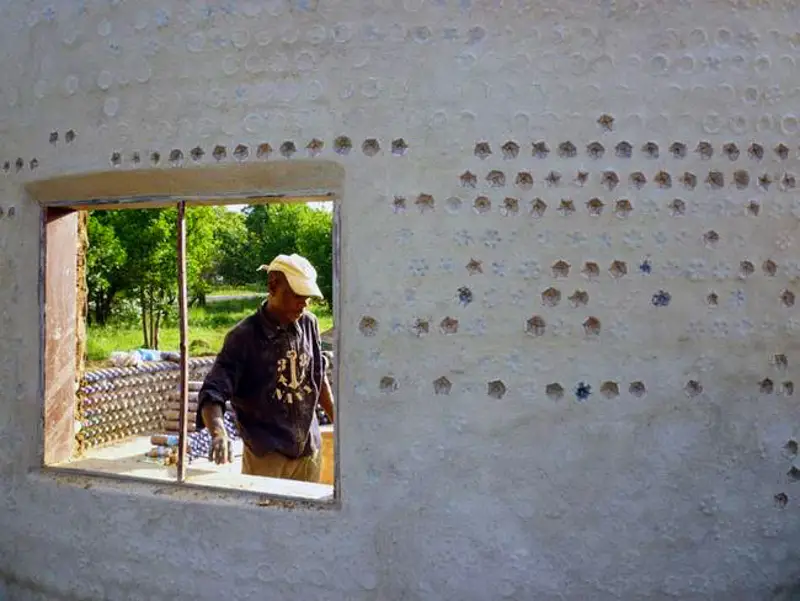
Nigerians Are Building Fireproof, Bulletproof, And Eco-Friendly Homes With Plastic Bottles And Mud
Amanda Froelich, True Activist
These colorful homes are bulletproof, fireproof, and can withstand earthquakes. They also maintain a comfortable temperature, produce zero carbon emissions, and are powered by solar and methane gas from recycled waste.
It is not enough to persuade people to use less, plastic needs to be repurposed and reused to be kept out of landfills. Despite informative infographics, emotional statistics, and recycling programs, many nations – especially the United States – continue to toss plastics into landfills without much care.
As phys.org reports, the housing crisis has become so bad in Nigeria, nearly 16 million units are required to address the shortage. Because crafting traditional homes would be far too expensive for most, locals adopted the idea put forth by two NGOs and are now building plastic bottle homes.
Founded by Kaduna-based NGO Development Association for Renewable Energies (DARE), with help from London-based NGO Africa Community Trust, the project is solving two problems at once by addressing the homelessness issue and helping the environment. Not only will there be less plastic in landfills, the house is designed to produce zero carbon emissions.
In addition, it is completely powered by solar panels and methane gas from recycled human and animal waste.
To create a two-bedroom bottle house, workers fill plastic bottles with sand and then hold them together using mud and cement. This forms a solid wall that is stronger than cinder blocks.
That’s not all: These colorful homes are bulletproof, fireproof and can withstand earthquakes. They can also hold a comfortable temperature year round.
The buildings can be built to three stories, but no higher, due to the weight of the sand-filled bottles. And, of course, the magnificent diversity of recycled bottles give each house a unique and bright look.
A two-bedroom house requires 14,000 bottles to complete. To put this into perspective, Nigeria throws away three million bottles every day. Clearly, there are plenty of bottles which can be repurposed to build every individual in their own abode.
At least Nigeria isn’t as wasteful as the United States, which discards 130 million bottlesper day. That’s 47 billion bottles every year – nearly 80% of which end up in the landfill.
If the United States were to save these bottles and repurpose them into houses like folks in Nigeria are doing, 9,257 houses could be builtper day. That is nearly 3.4 million houses a year, reports Off Grid World. With 3.5 million people living on the streets in the U.S., is this the solution needed to remedy the homelessness crisis?
Whether or not Einstein equated bee extinction to human extinction has been challenged and perhaps debunked. He may have never said anything close to that. After all, he was a physicist, not a biologist. But no matter. The diversity of our crops is highly dependent on pollinators, predominantly by honey bees and somewhat further by butterflies.
In 1976, retired apiculturist S.E. McGregor, from the USDA’s Agriculture Research Service (ASR), wrote a paper in 1976 entitled “Economics of Plant Pollination”. After mentioning that some plants are wind or self pollinated, McGregor stated, “… it appears that perhaps one-third of our total diet is dependent, directly or indirectly, upon insect-pollinated plants.”
In his 1976 paper, McGregor also points out, “Another value of pollination lies in its effect on quality and efficiency of crop production. Inadequate pollination can result not only in reduced yields but also in delayed yield and a high percentage of culls or inferior fruits. In this connection, Gates (1917) warned the grower that, … ‘without his pollinating agents, chief among which are the honey bees, to transfer the pollen from the stamens to the pistil of the blooms, his crop may fail.’”
Now We Have Colony Collapse Disorder
It’s well known to those who care about our future food supply that bee populations are dying off dramatically, and certain pollinating butterfly species, especially Monarchs, are becoming endangered.
Sometimes the bees simply get confused and don’t return to their hives, and sometimes they simply die in their hives. It’s known as Colony Collapse Disorder (CCD), and it has been rampant in North America. Neonicotinoids are the most widely used pesticides in the world and are extremely toxic to bees and other pollinators.
European scientists have discovered that bee populations are experiencing a resurgence after three neonicotinoid insecticides, clothianidin, imidacloprid and thiamethoxam were banned by the European Commission in 2013. Unfortunately, all three are still used heavily in the USA.
The European Academies Science Advisory Council, an independent body composed of representatives from the national science academies of European Union member states, has a growing body of evidence that shows the widespread use of the pesticides “has severe effects on a range of organisms that provide ecosystem services like pollination and natural pest control, as well as on biodiversity.”
The European ban is up for review this year, and the council’s report, based on the examination of more than 100 peer-reviewed papers that were published since the food safety agency’s finding, was prepared to provide officials with recommendations on how to proceed. Hopefully science will prevail over political influence from agrochemical industries.
Predatory insects like parasitic wasps and ladybugs provide billions of dollars’ worth of insect control, they noted, and organisms like earthworms contribute billions more through improved soil productivity. All are harmed by the pesticides and herbicides as well. Using pesticides is like trying to put out a fire by shooting at firemen as they arrive at the scene.
You can include glyphosate herbicides as well. Dr. Donald Huber, 55 year government plant pathologist and Purdue University professor emeritus suggests strongly that glyphosate herbicides contribute to pollinating bees’ confusion, causing them to not be able to return to their hives. That’s one part of CCD, the other part is when whole hive colonies die in or near their hives.
Despite Huber’s strong background and integrity, he has been ignored and vilified for his attempts at warning the corrupt creeps in the USDA and academia. They are all on the GMO industry’s payroll, directly or indirectly.
Perhaps Big Ag mono-crop farmers are too ignorant of older methods of agroecology insect control or perhaps their farms are too big or they’re too lazy and greedy. Or perhaps they’re simply victims of a failed system known as Big Ag with its handful of large worldwide distributors and a commodity speculative trading system that influences food pricing.
The solution to a sustainable food supply has been determined by several international studies from agricultural experts not attached to specific Big Ag or biotech industries; the largest was assigned to international experts by the United Nations. Their proposed solution to world hunger is small organic agroecological farms that supply food within their regions.
These studies received little or no mainstream media publicity. And the practices they advocate receive no government subsidies. Instead, the loudest and most quoted voices for solving world hunger are from GMO shills.
Paul Fassais a contributing staff writer for REALfarmacy.com. His pet peeves are the Medical Mafia’s control over health and the food industry and government regulatory agencies’ corruption. Paul’s contributions to the health movement and global paradigm shift are well received by truth seekers. Visit his blog by following this link and follow him on Twitter here